Forgotten Foes I’d Love to See Return After the Gleeok Revival
I still remember the first time I stumbled across a Gleeok in The Legend of Zelda: Tears of the Kingdom. I was gliding through the Hebra Mountains, minding my own business, when the sky suddenly turned crimson and a monstrous roar echoed across the frozen peaks. Beneath me, a towering three-headed dragon—each skull crackling with elemental fury—had locked all six of its eyes onto my pathetic little paraglider. That initial panic, the frantic scramble to craft ice arrows, and the eventual triumph of bringing down such a primordial beast remains one of my most vivid gaming memories from 2023. Even now, in 2026, whenever I revisit Hyrule, I make a deliberate detour to dance with those dragons again. What made that encounter so striking wasn’t just the fight itself—it was knowing that Gleeoks had been absent from the series for over three decades. They were resurrected from the original NES classic, and their modern reimagining made me wonder: what other forgotten monstrosities are gathering dust in Zelda’s history, waiting for a similar renaissance?
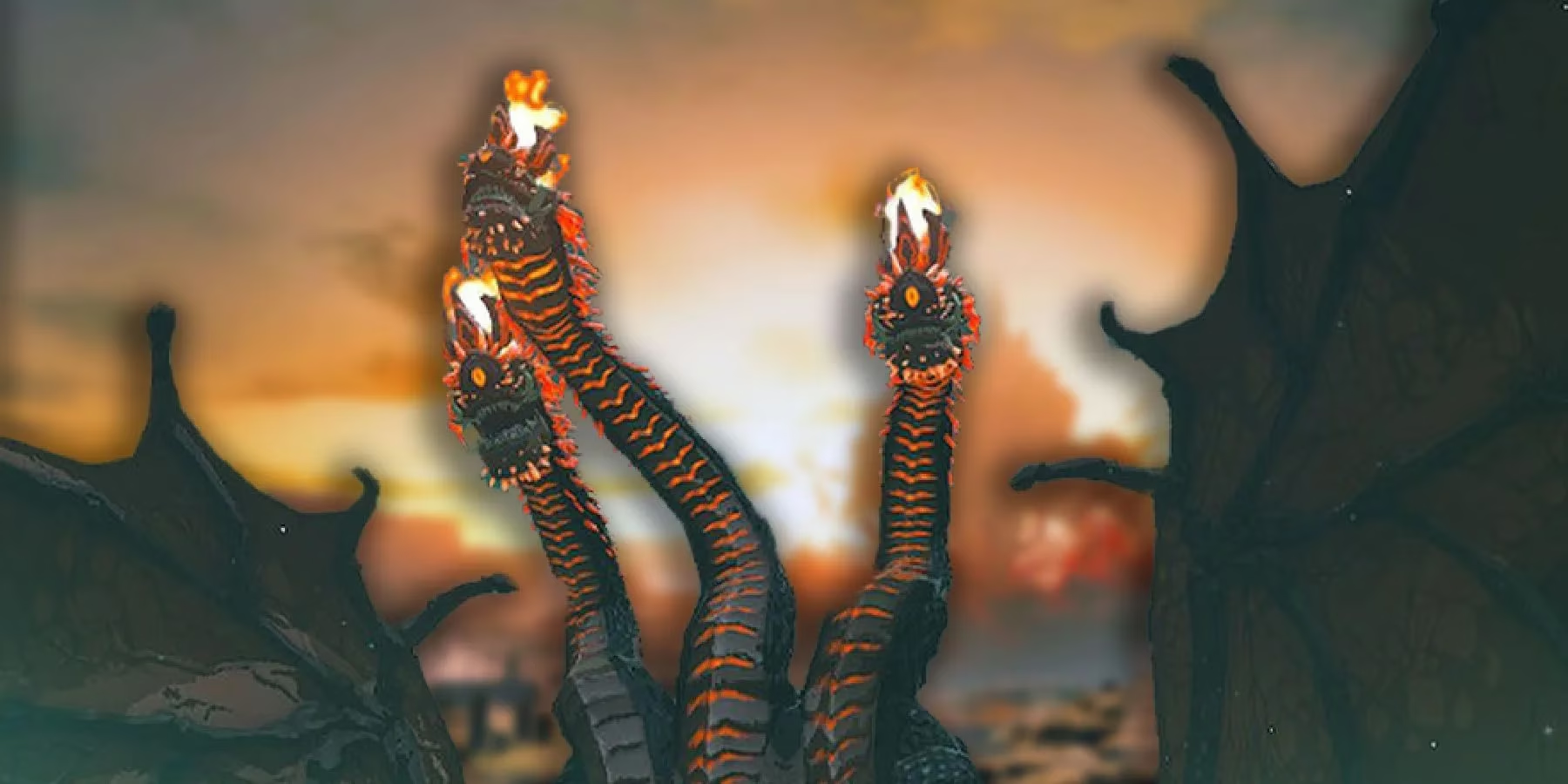
Every time I face a Gleeok now, I’m reminded of how perfectly its ancient mechanics translate to a modern open-air Zelda. The original beast was a simple multi-headed dragon that fired projectiles and had to be struck in each head; Tears of the Kingdom took that blueprint and infused it with verticality, elemental interplay, and the sheer spectacle of Link diving through storm clouds to deliver the final blow. That success got me thinking—there’s a whole vault of enemies from the series’ earliest days that only appeared once or twice before being inexplicably abandoned. They’re weird, often grotesque, and brimming with untapped potential. If Nintendo could make a Gleeok feel this fresh, imagine what they could do with these relics.
The Patra is chief among my wishlist additions. I encountered this floating horror only through emulation and retro collections, yet its design has stuck with me for years. It’s a giant, pulsating eyeball surrounded by a constellation of smaller eyes that orbit protectively around it. In the original Legend of Zelda, fighting a Patra was a frantic ballet of dodging and timing, but the NES hardware restricted the idea to a static room. In a contemporary title, this creature could become a breathtaking aerial boss. I can picture it hovering above the Gerudo Desert, its satellite eyes whipping through the air in complex patterns, forcing me to use Recall on the projectiles they fire or to weave bullet-time arrow shots between their orbits. Destroying each smaller eye would agitate the central mass, causing it to emit blinding light pulses or even warp Link to a pocket dimension for a secondary phase. Its single appearance in the series feels like a crime, and I’d argue it deserves the Gleeok treatment more than almost any other foe.
Then there’s Aquamentus, a dragon that is both familiar and alien. Unlike the elemental Gleeoks, Aquamentus was a horned, unicorn-like dragon that guarded dungeons in the first game. It spewed fireballs and moved with an awkward, loping gait, but its appearance has never been replicated. I’ve often daydreamed about meeting an Aquamentus while exploring the coastline in a future game—perhaps it could rise from the ocean foam during a storm, its body slick with seaweed and barnacles, unleashing blasts of pressurized water instead of simple fireballs. Modern water physics would let it flood the battlefield, forcing me to build platforms or climb crumbling ruins to stay above the waves. It’s a design that could bridge the gap between draconic terror and the more serene dragon spirits we’ve seen in other titles.
Digging deeper into the archives, Zelda 2: The Adventure of Link offers a treasure trove of one-off nightmares. That game is often treated as the series’ weird cousin, but its enemy roster is delightfully unhinged. The Acheman is a prime example—a humanoid bat creature that swoops down from Death Mountain’s caverns and breathes fire. I remember reading about its ability to transform into a swarm of smaller bats upon defeat, and instantly my mind raced with possibilities. A modern Acheman boss could start as a towering, armored chiropteran that duels Link with a sword of its own, then, when defeated, it collapses into a cloud of screeching Keese that I’d have to disperse with a well-timed shock arrow or a whirlwind from a Korok frond. It would be a clever callback to its original transformation and a chance to use crowd-control tactics rarely demanded in boss arenas.
The same game also introduced humanoid high-tier enemies that feel tailor-made for the Lynel-style mini-boss slot. The Fokka and Fokkeru are bird-like warriors that wield swords and shields with terrifying aggression, leaping from wall to wall in the Great Palace. I’ve always thought they could rival Lynels for sheer intimidation if given a modern polish—imagine a silent, feathered knight patrolling a ruined Sky Island, its metallic wings catching the light before it dive-kicks you off a crumbling ledge. The Daira and Guma are equally promising: crocodilian axemen and club-wielding brutes that could guard humid jungle temples or volcanic depths, each demanding precise parries and flurry rushes to overcome.
Then there’s Rebonack, a boss that remains one of Zelda 2’s most surreal images. It’s an Iron Knuckle warrior riding a floating, translucent horse. The jousting-like battle was clumsy in the 1980s, but in a series that now has refined horse mechanics and mounted combat, this concept is ripe for reinvention. I can envision a Rebonack fight where I’m forced to summon my own steed, galloping across an ethereal plain while the ghostly knight hurls spears and charges with lance leveled. It would be a direct fusion of Zelda’s horseback traditions with a phantasmal adversary, elevating both nostalgia and gameplay.
What ties all these enemies together is that they’re not just potential bosses—they’re embodiments of the series’ experimental past. Bringing back a Gleeok worked because it honored that past while making the encounter feel indispensable to Tears of the Kingdom’s identity. In 2026, as we await the next major Zelda title, I find myself poring over old manuals and sprites, hoping that the developers see what I see: an opportunity to unearth more forgotten terrors and weld them into unforgettable experiences. Whether it’s a swirling Patra or a mounted Rebonack, these creatures deserve to roar back into Hyrule not as mere easter eggs, but as fully realized legends. And when that day comes, I’ll be ready—with a full quiver and a heart pounding with that same Gleeok-induced thrill.
Discussion