Mastering the Narrative: How 'The Legend of Zelda: Tears of the Kingdom' Reimagined the Master Sword's Legacy
In the landscape of modern gaming, few titles have managed to captivate audiences and critics alike as profoundly as The Legend of Zelda: Tears of the Kingdom. Released to widespread acclaim, this sequel to Breath of the Wild has carved a unique niche for itself, celebrated for its unparalleled player freedom and a cinematic, emotionally resonant story. From the poignant revelations hidden within the Dragon's Tears flashbacks to the audacious possibility of confronting Ganondorf immediately after acquiring the paraglider, the player's journey is an experience distinct from any prior entry in the storied franchise. At the heart of this innovative narrative lies a reimagined treatment of Link's most iconic artifact: the Master Sword.
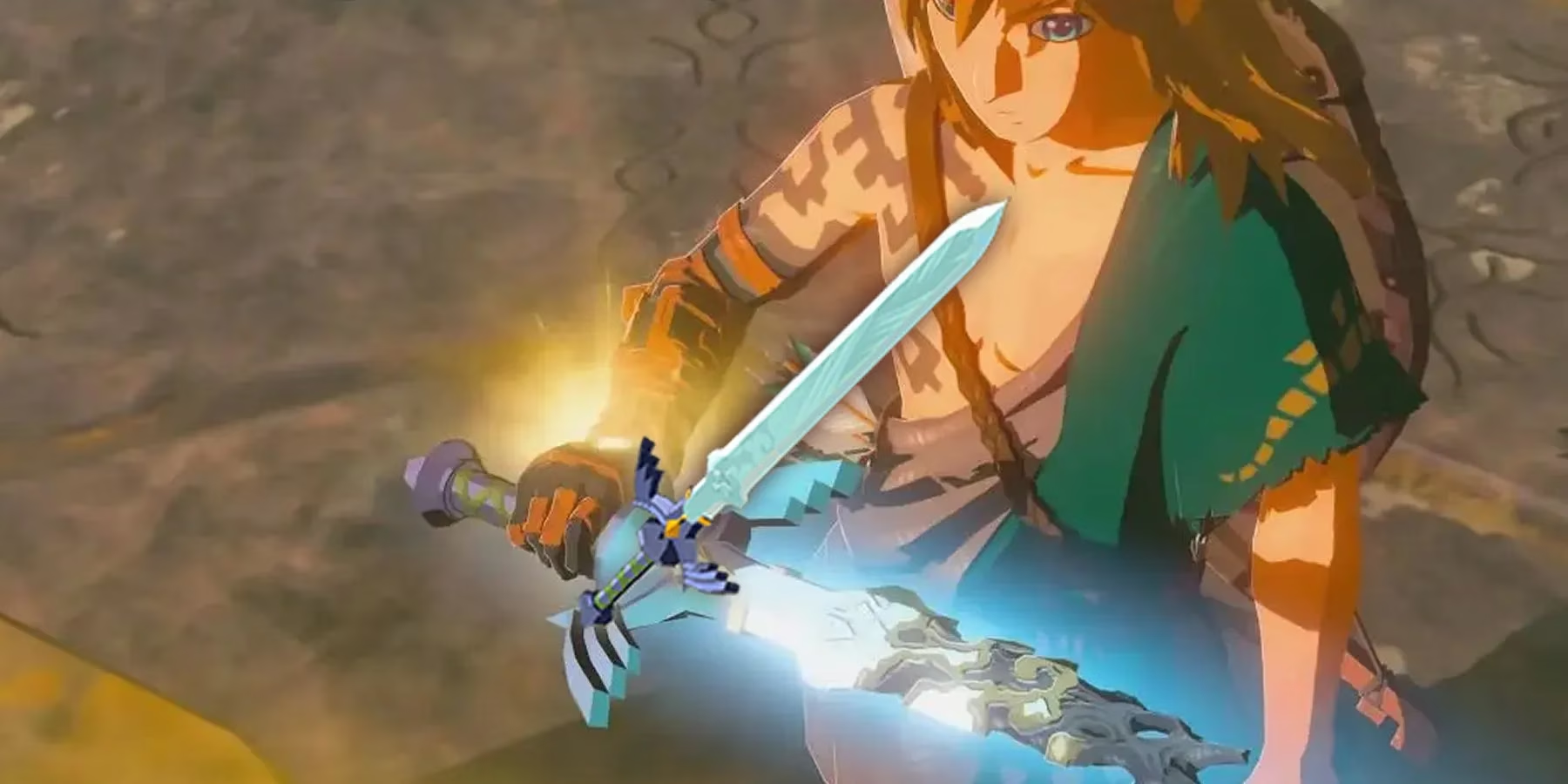
A Sword's Journey: From Asset to Narrative Keystone
One of the most significant departures Tears of the Kingdom makes from its predecessors is the profound narrative importance it bestows upon the Master Sword. Traditionally, the Blade of Evil's Bane often serves as a late-game reward, patiently awaiting Link on a pedestal after he completes a series of daunting trials. However, Tears of the Kingdom subverts this expectation from the outset. Set after the events of Breath of the Wild, Link begins his adventure already in possession of the legendary weapon. To create a compelling narrative challenge, the developers ingeniously wove the sword's fate directly into the core story.
The game's opening sequence sees Link and Zelda investigating the depths beneath Hyrule Castle, where they are ambushed by the resurrected Ganondorf. This catastrophic encounter not only strips Link of the health and stamina accrued in the previous game but also results in the Master Sword being grievously damaged. When Link regains consciousness, he finds the sword in a pitiful state, its blade corrupted and seemingly decaying. This moment establishes a powerful emotional hook—the hero's signature weapon, a symbol of hope, is broken.
Temporal Threads and Sacrificial Bonds
The narrative ingenuity deepens when, during the introductory segment, a mysterious orb of light appears and whisks the damaged Master Sword away into the distant past. This act sets in motion a complex, time-bending plot where the actions of Zelda and Link become inextricably linked across centuries. The appearance of the majestic Light Dragon soaring through the skies of Hyrule becomes a central mystery, its connection to the lost sword and the kingdom's salvation slowly unfurling as players explore.
In essence, the Master Sword is not merely a tool for combat; it is the linchpin of the entire story. Its journey to the past directly causes Princess Zelda to undergo a profound transformation, consuming a Secret Stone to become the immortal Light Dragon. For millennia, she flies over Hyrule, her tears manifesting as the mystical Zonai blessings that aid Link, while her very being nurtures and restores the Master Sword to its full, radiant power. This restoration is so critical that the game ensures players cannot face the final confrontation without it. If one reaches the climactic battle against the Demon Dragon without having claimed the sword, the game triggers a breathtaking sequence where Link finally retrieves it from the Light Dragon's head, a moment of immense narrative and emotional payoff.

Lessons for Future Adventures: Principles of Poignant Storytelling
While the Master Sword has been a staple of Link's adventures, its narrative weight has fluctuated across the series. Tears of the Kingdom demonstrates that there are still profoundly meaningful stories to tell where the acquisition and significance of the weapon are seamlessly integrated into the central quest. For future titles aiming to replicate the emotional impact of this game, several key principles emerge:
-
Integrate from the Start: The pivotal item—be it the Master Sword or another artifact—should be tied to the adventure's story from the very beginning, rather than being a distant objective waiting in a dungeon. This creates immediate investment and mystery.
-
Weave, Don't Isolate: The tools Link needs should be intertwined with the main story's enigma, acting as clues and catalysts for revelation, but they should not constitute the entire mystery themselves. The journey to understand why is as important as obtaining the what.
-
Craft a Spectacle: The moment of obtaining the crucial item should be a visual and emotional spectacle, a reward for the player's perseverance. The Light Dragon sequence is a masterclass in this, marking the resolution of a central mystery with awe-inspiring grandeur.
The Value of Earned Significance
These three elements coalesce in Tears of the Kingdom to make the Master Sword's revival feel earned and profoundly worthwhile. The game pushes players to ask questions—Who is the Light Dragon? What happened to Zelda? How can the sword be fixed?—and parcels out answers at narratively perfect moments, culminating in a climax that is both spectacular and deeply poignant. By making the sword's restoration a central mystery intertwined with Zelda's ultimate sacrifice, the game elevates the weapon from a powerful stat stick to the very soul of the narrative.
While the specific, time-bending climax of Tears of the Kingdom may be a high bar to clear, the underlying lesson for future Zelda adventures is clear: iconic elements gain new life when they are meaningfully embedded into the story's emotional core. Whether through the Master Sword or other legendary artifacts, the potential to reward players with unexpected, heartfelt narratives is what keeps the spirit of adventure alive and makes these journeys worth undertaking. The legacy of the Master Sword, thanks to this title, is now not just one of power, but one of profound narrative purpose.
Discussion