The Spear and Hover Stone Trick That Conquered All 81 Addison Signs
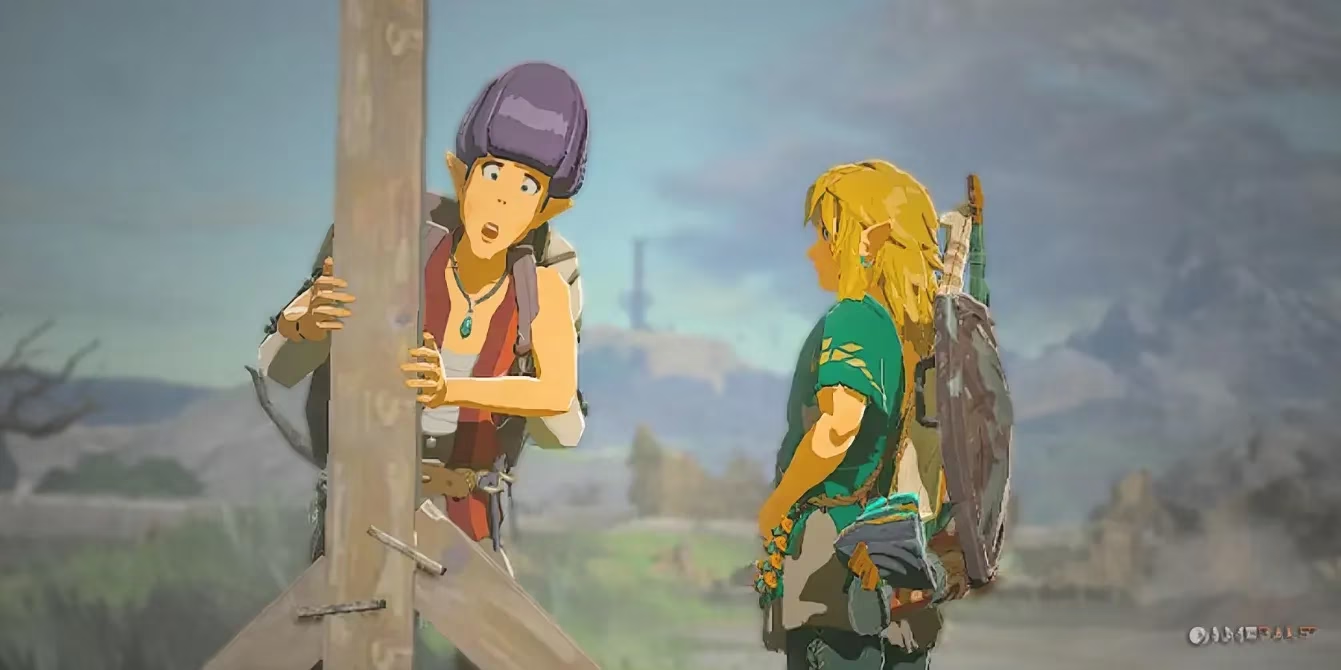
Three years had passed since Link first set foot on the Sky Islands of Hyrule, yet a particular carpenter named Addison continued to baffle adventurers. Standing beside his wobbly President Hudson signposts, he would plead for help—eighty-one times across the kingdom. By 2026, many players had memorized every rock pile and wooden plank needed to prop up those infuriating billboards. Others had simply given up, leaving Addison to mutter his desperate sales pitch into an empty field. But in the depths of the Zonai research community, a question simmered: could there be one perfect, universal solution?
The answer arrived on a quiet evening when a Reddit user known as castorshell13 uploaded a video that made the Tears of the Kingdom community collectively gasp. The footage showed Link approaching a signpost, not with a bundle of logs, but with a simple spear—one fused with a Zonai Hover Stone. With a casual overhand throw, the weapon arced through the air and lodged itself directly beneath the signage. The Hover Stone detached, activated in midair, and floated serenely just under the wooden board. Addison hammered away, the post stayed perfectly still, and the puzzle was solved in under five seconds. No teetering contraptions, no frantic Ultrahand adjustments, no swearing at the physics engine. Just one spear, one stone, and a dash of ingenuity.
How could such an elegant trick have escaped notice for so long? The community was quick to deconstruct the method. The Hover Stone, when attached to a thrown weapon, registers the impact with the signpost as a separation event. It then deploys its anti-gravity field automatically, creating a stable shelf directly beneath the wobbling target. Because the stone hovers without any support, it doesn’t tilt or slide, making it the perfect temporary brace. And here was the real revelation: unlike other fused items, the Hover Stone could be retrieved and reattached to the same spear after Addison finished his work. The only cost was the durability of the weapon itself—a negligible price for a seasoned adventurer with a stash of royal broadswords.
Of course, not everyone greeted this discovery with unbridled enthusiasm. Some purists argued that wasting any Zonai device on a sign puzzle, even a recoverable one, violated the spirit of creative construction. “Isn’t the whole point to experiment with different materials?” they asked. After all, each of the eighty-one signs presented a unique environmental challenge. One sat on a sheer cliff, another teetered on a lopsided hill, and a third was surrounded by a circle of spikes. The joy came from scouring the nearby ruins for the exact combination of stone slabs and metal beams needed to triumph. What satisfaction did one gain by simply throwing a magical spear and calling it a day?
But for every detractor, ten more champions rallied behind castorshell13’s method. They pointed out that not every player had the luxury of time. Between battling Gloom Spawn in the Depths and hunting Korok seeds, the prospect of manually solving all eighty-one sign puzzles could drain dozens of hours. The spear trick reduced the total time commitment to mere minutes. Speedrunners, in particular, hailed it as a revolution. In the competitive Tears of the Kingdom circuits of 2025, the “All Hudson Signs” category had suddenly become attainable for anyone with a fused spear and a handful of Hover Stones. The trick also proved a godsend for completionists who had returned to the game years later, eager to polish off their 100% maps without revisiting the frustrations of broken balane structures.
Yet the method was not without its delicate nuances. As castorshell13 patiently explained in follow-up posts, the throw had to be aimed precisely—just below the signboard, not at the post itself. A millimeter too high and the Hover Stone would clip through the wood, sending the entire sign spinning into the void. Too low and the stone would embed itself uselessly in the ground. The angle of the spear also mattered; a steep overhead throw worked best, while a sidearm toss often ended in disaster. Mastering this throw became a new mini-game in itself. Players shared their own footage of cursed throws—one unfortunate adventurer watched his spear ricochet off a rock and detonate a nearby bomb barrel, sending Addison tumbling down a hillside with a yelp. The community laughed, commiserated, and refined the technique together.
Three years after its discovery, the spear-and-Hover-Stone method had evolved from a niche cheat into a cultural touchstone. Fan artists drew Link posing with his “sign-killer” spear. Modders created Hover Stone spear replicas that could be wielded in other games. Addison even received a line of ironic appreciation: “At least now I see you more often!” his digital dialogue quipped whenever a player used the trick. The trick had become part of Hyrule’s living history.
But what of those who still refused to use it? They, too, had their stories. A dedicated player named Maren spent the spring of 2026 constructing a mobile platform that could solve any sign puzzle without a single Zonai device—using only stone, wood, and sheer determination. Her setup took ten times longer per sign but she insisted the feeling of each unique solution was worth it. “Isn’t the struggle the real reward?” she asked her streaming audience. The answer, as always, depended on the adventurer. In the end, the beauty of Tears of the Kingdom lay in its flexibility. One player’s tedious chore was another’s creative playground.
The Hover Stone spear trick remained, a testament to the resourcefulness of the community. It reminded everyone that even in a world as vast as Hyrule, a simple question—What if I just throw something at it?—could change everything. And somewhere at a lonely construction site, Addison still waited, ready to be saved in seconds or savored for an hour, depending entirely on who happened to be holding a spear.
Discussion