The Wild West in Your Pocket: RDR2's Mobile Frontier and the Future of Gaming
As I sit here in 2026, my fingers tracing the smooth glass of my smartphone, I find myself marveling at the journey we've taken. Who would have thought that the vast, untamed wilderness of Red Dead Redemption 2—a world that once demanded the might of a console or a high-end PC—could whisper its tales from the palm of my hand? The very idea feels like a poetic contradiction, doesn't it? The grandest of epics, condensed into the most personal of devices. It makes me wonder: are we not all cowboys now, riding the digital plains from the comfort of our own hearths, the campfire glow replaced by the cool light of an OLED screen?
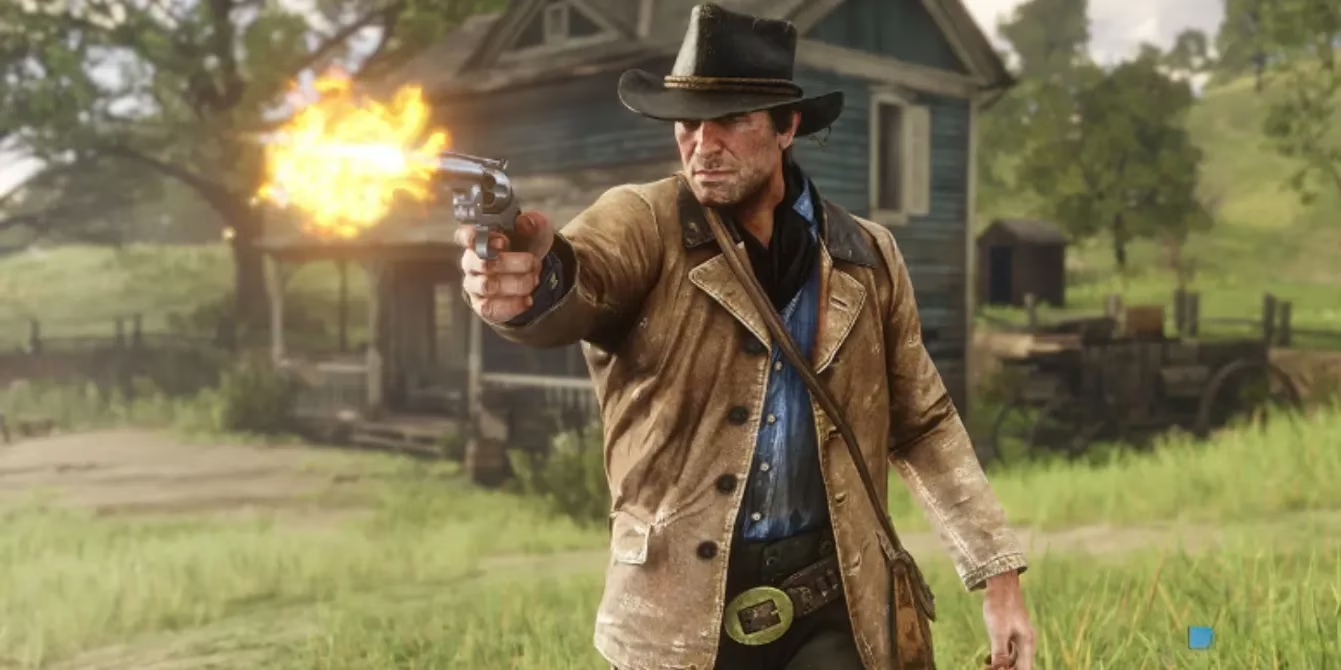
I remember watching, with a sense of awe bordering on disbelief, as pioneers like Serg Pavlov first dared to lasso this behemoth. The attempt itself was a statement. Using a device forged for gaming, the Red Magic 9 Pro, they summoned Arthur Morgan from the ether. There he was—a ghost in the machine—riding his horse across a screen no larger than my hand. Was it perfect? Far from it. The early steps onto this new frontier were fraught with struggle:
-
A Choppy Gallop: The frame rate stumbled like a horse on rocky ground.
-
Ghostly Textures: The world's rich detail sometimes faded, becoming a pale imitation of itself.
-
Stuttering Echoes: Even the sound seemed to gasp for breath, breaking the immersive silence of the plains.
And yet... there was magic in that imperfection. To see the lantern-lit streets of Saint Denis, however flickering, on a device I carry in my pocket? It felt like witnessing a miracle. The video was a testament to raw ambition. When Arthur stood still, the world would steady itself, offering a glimpse of the serene beauty Rockstar crafted. But ask him to run, to fight, to live—and the phone would strain under the weight of its own dream. Could it handle a raging shootout in Valentine? I feared the device might simply sigh and turn to ash in the attempt. But isn't that the essence of a frontier? To go where the path is unclear, simply because it exists?
This was never about flawless execution. It was about possibility. It asked a silent, profound question of us all: What are the true boundaries of our digital worlds? If Red Dead Redemption 2, a titan of environmental storytelling and character depth, could take its first, faltering steps on mobile, what did that herald for the future?
| Then (The Pioneer's Test) | Now (The 2026 Reality) |
|---|---|
| 🐎 Severe FPS drops & stuttering | 🐎 Cloud streaming enables buttery-smooth 60fps gameplay |
| 🏜️ Texture pop-in and graphical bugs | 🏜️ Adaptive resolution scaling preserves visual fidelity |
| 🔫 Physics-intensive scenes risked crashing | 🔫 Dedicated mobile SOCs handle complex physics with ease |
| 📱 Confined to specific high-end hardware | 📱 Accessible via subscription services on most modern devices |
Look at how far we've come. What began as a passionate experiment by a dedicated YouTuber has blossomed into a legitimate pathway. I can now access entire libraries of once-impossible games through cloud streams, their worlds rendered on distant, powerful servers and painted onto my screen. The stuttering ghost of Arthur on that Red Magic phone was the first whisper of this revolution. He was the scout who crossed the mountain, signaling that the territory beyond was reachable.
So, what does this mean for us, the players who carry entire universes in our pockets? It means the line between "console-quality" and "mobile" has not just blurred—it has dissolved in a haze of pixelated sunset. The compelling characters, the moral quandaries, the sheer weight of Arthur Morgan's story are no longer anchored to the living room. They accompany us on commutes, in waiting rooms, under the covers late at night. The game's environmental design, once a benchmark for home theaters, now also serves as a benchmark for personal, intimate escapism.
I think of Rockstar's silence on the matter, and I smile. They built a monument to interactive art. The fact that we, the players and tinkerers, are finding new temples in which to house it—from phones to cloud portals—is perhaps the greatest tribute of all. The soul of the game, its heart of rust and gold, proves to be portable. The future of gaming isn't just about more polygons or louder explosions. It's about ubiquity. It's about the freedom for a story to find you wherever you are.
Perhaps that YouTuber's shaky, stuttering video was the first campfire story of a new era. We huddled around that small, glowing rectangle and saw a prophecy. And now, here we are, living in it. The Wild West is no longer a place you go to. It's a place that follows you, forever just a tap away, waiting to welcome you back under its vast, digital sky. 🤠✨
Discussion